
Universal Pipette Tips
Disposable pipette tips designed to fit single and multichannel pipettes from most manufacturers; offer acceptable performance compared to pipette specific tips and can be used with a variety of pipette models.
Single-use universal pipette tips are designed for compatibility with most mechanical and electronic single and multichannel pipettors.
Universal pipette tips are available in a range of types, sizes, colors, styles, and packaging configurations and may be designed for specific purposes or tasks.
- Capacity or volume based on the pipettor size
- Filters to reduce contamination and cross-contamination
- Color
- Sterility or autoclavability
- Tip style: beveled, tapered, wide bore, round, flat, or gel-loading
- Length: short or extended
- Purity: metal-free or DNase-, RNase-, ATP-, Bioburden-, PCR inhibitor-, endotoxin-, or pyrogen-free for genomic and biologic applications
- Surface treatments to reduce retention
- Packaging options to help facilitate re-stocking or eliminate waste


ABclonal Technology [KO Validated] CRMP2/DPYSL2 Rabbit pAb

This gene encodes a member of the collapsin response mediator protein family. Collapsin response mediator proteins form homo- and hetero-tetramers and facilitate neuron guidance, growth and polarity. The encoded protein promotes microtubule assembly and is required for Sema3A-mediated growth cone collapse, and also plays a role in synaptic signaling through interactions with calcium channels. This gene has been implicated in multiple neurological disorders, and hyperphosphorylation of the encoded protein may play a key role in the development of Alzheimers disease. Alternatively spliced transcript variants encoding multiple isoforms have been observed for this gene.


ABclonal Technology MAP3K8 Rabbit pAb
This gene is an oncogene that encodes a member of the serine/threonine protein kinase family. The encoded protein localizes to the cytoplasm and can activate both the MAP kinase and JNK kinase pathways. This protein was shown to activate IkappaB kinases, and thus induce the nuclear production of NF-kappaB. This protein was also found to promote the production of TNF-alpha and IL-2 during T lymphocyte activation. This gene may also utilize a downstream in-frame translation start codon, and thus produce an isoform containing a shorter N-terminus. The shorter isoform has been shown to display weaker transforming activity. Alternate splicing results in multiple transcript variants that encode the same protein.

ABclonal Technology TAF1 Rabbit pAb
This gene encodes the largest subunit of TFIID, a basal transcription factor required for RNA polymerase II activity. TFIID binds to the core promoter to position the polymerase and assembles the transcription complex. It also serves as a channel for regulatory signals and interacts with activators and other regulators to influence transcription initiation. This subunit contains two protein kinase domains and has acetyltransferase activity, acting as a ubiquitin-activating/conjugating enzyme. Mutations in this gene cause Dystonia 3, torsion, X-linked, a dystonia-parkinsonism disorder. Alternative splicing results in multiple transcript variants, some sharing exons with TAF1 and additional downstream DYT3 exons.
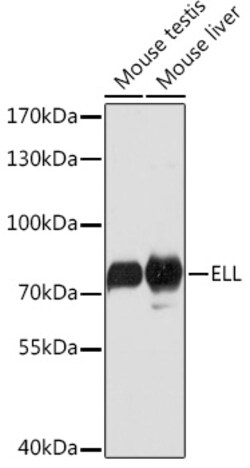
ABclonal Technology ELL Rabbit pAb
Enables phosphatase binding activity. Involved in positive regulation of transcription, DNA-templated and snRNA transcription. Located in cytosol, nuclear body, and transcriptionally active chromatin. Part of transcription elongation factor complex.

ABclonal Technology RANBP1 Rabbit pAb
This gene encodes a protein that forms a complex with Ras-related nuclear protein (Ran) and metabolizes guanoside triphosphate (GTP). This complex participates in the regulation of the cell cycle by controlling transport of proteins and nucleic acids into the nucleus. There are multiple pseudogenes for this gene on chromosomes 9, 12, 17, and X. Alternative splicing results in multiple transcript variants.

ABclonal Technology ITGA10 Rabbit pAb
Integrins are integral transmembrane glycoproteins composed of noncovalently linked alpha and beta chains. They participate in cell adhesion as well as cell-surface mediated signalling. This gene encodes an integrin alpha chain and is expressed at high levels in chondrocytes, where it is transcriptionally regulated by AP-2epsilon and Ets-1. The protein encoded by this gene binds to collagen. Alternative splicing results in multiple transcript variants.

ABclonal Technology SLC25A20 Rabbit pAb
This gene product is one of several closely related mitochondrial-membrane carrier proteins that shuttle substrates between cytosol and the intramitochondrial matrix space. This protein mediates the transport of acylcarnitines into mitochondrial matrix for their oxidation by the mitochondrial fatty acid-oxidation pathway. Mutations in this gene are associated with carnitine-acylcarnitine translocase deficiency, which can cause a variety of pathological conditions such as hypoglycemia, cardiac arrest, hepatomegaly, hepatic dysfunction and muscle weakness, and is usually lethal in new born and infants.

ABclonal Technology TCHH Rabbit pAb
The protein encoded by this gene forms crosslinked complexes with itself and keratin intermediate filaments to provide mechanical strength to the hair follicle inner root sheath. The encoded protein also is important for structural integrity of the filiform papillae of the tongue. Defects in this gene are a cause of uncombable hair syndrome.

ABclonal Technology MED18 Rabbit pAb
MED18 is a component of the Mediator complex, which is a coactivator for DNA-binding factors that activate transcription via RNA polymerase II (Sato et al., 2003 [PubMed 12584197]).

ABclonal Technology CSRP1 Rabbit pAb
This gene encodes a member of the cysteine-rich protein (CSRP) family. This gene family includes a group of LIM domain proteins, which may be involved in regulatory processes important for development and cellular differentiation. The LIM/double zinc-finger motif found in this gene product occurs in proteins with critical functions in gene regulation, cell growth, and somatic differentiation. Alternatively spliced transcript variants have been described.

Thomas Scientific SHARP Precision Barrier Tips, For P-200, 200µl, 4800/cs
SHARP precision barrier tips eliminate false signals and cross contamination caused by aerosols. SHARP tips feature Denville's new low retention polymer technology that virtually eliminates sample retention. Our inert hydrophobic barrier prevents pipettor contamination without trapping liquid or contaminating samples. These tips provide the most accurate sample delivery in the industry. They contain no nucleic acids, PCR inhibitors, detectable nucleases or endotoxins. All sizes are natural color, presterilized and free of metallic content.


ABclonal Technology DDX31 Rabbit pAb
DEAD box proteins, characterized by the conserved motif Asp-Glu-Ala-Asp (DEAD), are putative RNA helicases. They are implicated in a number of cellular processes involving alteration of RNA secondary structure such as translation initiation, nuclear and mitochondrial splicing, and ribosome and spliceosome assembly. Based on their distribution patterns, some members of this DEAD box protein family are believed to be involved in embryogenesis, spermatogenesis, and cellular growth and division. This gene encodes a member of this family. The function of this member has not been determined. Alternative splicing of this gene generates multiple transcript variants encoding different isoforms.

ABclonal Technology LPAR2 Rabbit pAb
This gene encodes a member of family I of the G protein-coupled receptors, as well as the EDG family of proteins. This protein functions as a lysophosphatidic acid (LPA) receptor and contributes to Ca2+ mobilization, a critical cellular response to LPA in cells, through association with Gi and Gq proteins. An alternative splice variant has been described but its full length sequence has not been determined.

ABclonal Technology MEAF6 Rabbit pAb
This gene encodes a nuclear protein involved in transcriptional activation. The encoded protein may form a component of several different histone acetyltransferase complexes. There is a pseudogene for this gene on chromosome 2. Alternative splicing results in multiple transcript variants.

ABclonal Technology SEC24D Rabbit pAb
The protein encoded by this gene is a member of the SEC24 subfamily of the SEC23/SEC24 family, which is involved in vesicle trafficking. The encoded protein has similarity to yeast Sec24p component of COPII. COPII is the coat protein complex responsible for vesicle budding from the ER. This gene product is implicated in the shaping of the vesicle, and also in cargo selection and concentration. Mutations in this gene have been associated with Cole-Carpenter syndrome, a disorder affecting bone formation, resulting in craniofacial malformations and bones that break easily. Alternative splicing results in multiple transcript variants encoding different isoforms.